Tuesday, December 27, 2011

Land Creatures


I keep posting pictures of the amazing underwater life of Shark Bay but have yet to show everything that we see on land as well.  Many people know Australia for its countless numbers of excessively poisoness creatures such as the funnel-web spider, the blue-ringed octopus, and the box jellyfish which have the ability to kill or incapacitate with a single bite or sting.  These are the famous ones, the illusive subject of people's fear and often their reason for second guessing a potential vacation down to this otherwise remarkable country.  As you might guess, the stories are exaggerated and the animals are generally far less common than it would seem.  In fact they are almost always rarities if they occur at all in a given area.  There is much more to be seen and in such a variety.


(Kirk Gastrich)


(Adriana Weil)


One Fancy Beetle (Adriana Weil)


Just above the head there is a beautiful blue stripe.

Mothra 


A Social Huntsman Spider (Adriana Weil)
I have always had a special place in my heart for spiders.  I am not sure why but in Ecuador I chose to study social spiders.  In animal behavior class I chose to do a report on the web building habits of the Hobo Spider in Oregon, and if you have not noticed before the name of this blog is Woven Threads which mainly refers to my attempt at weaving together the random ideas and strands of thought that run through my head but it has another obvious connection to the world of spiders.

It is only in retrospect that I have noticed this pattern.  Here in Australia they have many dangerous and fascinating spiders.  The Huntsman Spider is not particularly dangerous, though it is large and aggressive.  I have had to help a few people out by ridding their sleeping quarters of the beasts now and I have to say I quite enjoyed it.  It is fun for me to watch and think about their actions.  Why do they do what they do?  What drives the choices that make?

The body of the wasp is about 2 inches long.
The other day when I was walking by the pool we noticed a large orange and black wasp wrestling with one of these Huntsman.  It turns out this wasp is called the Spider Hunting Wasp.  It searches out Huntsman Spiders and delivers them with a paralyzing sting.  It will then drag the spider to a burrow and burry it but not before laying a single egg on the spiders abdomen.  The egg hatches and then feeds on the spider until it ready to emerge.  Gruesome but spectacular.  The adult wasps are not even carnivorous.  They feed on the nectar of plants and their flowers.  Wasps are pretty cool too.


Red Back Spider, a close relative to the Black Widow. (Adriana Weil) 


The Birds of australia are an exciting bunch, from the tiny little Fairy Wrens that flit about in the bush to the Emu that plods its way along the roads.  There is a group of  either Collared Sparrowhawks or possibly Brown Goshawks that live right by our trailers.  Every day I hear them call kree-kree-kree and watch them chase the Galahs all around Monkey Mia.  The Welcome Swallows seem to stay pretty well away from that action and go about their business of catching insects on wing most of the day.  The Pelicans and Cormorants (called Shags in Australian) are all over the water.  Most people find them annoying and obtrusive but they can be quite interesting to watch.  

One of my favorite birds here is the Crested Tern.  There are several types of terns that we see each day but whenever I go down to the beach for a swim there is a little Crested Tern that sits on a post out in the water.  I like to swim out to it to get as close as I can and because the post sticks far enough out of the water the bird does not feel threatened by my presence.  I can move right up to it, the bird only a foot or two from my head.  I watch it and chat with it to keep it calm while it watches me and hopefully keeps a look out for any approaching sharks.  I can't get down to the beach every day but most days when I do there is a Crested Tern sitting on that post waiting.


Emu (Adriana Weil)

Emu chicks (Adriana Weil)

Galah (Adriana Weil)


Galahs (Adriana Weil)
Welcome Swallow (Fanny Vessaz)

Sparrowhawk and Galah (Adriana Weil)

Collared Sparrowhawks (Adriana Weil)

Australian Pelican


The lizards of this country are an interesting bunch.  There is an entire group called legless lizard which is exactly what the name implies.  They are not snakes though it would be easy to mistake them for such.  Down below I have put in a picture, though a bit blurry, of a skink called the Unpatterned Robust Slider which actually does have some vestigial legs.  They are little more than nubs helping the Slider to make its way along in the sandy terrain.  The only snake we have come across so far has been the Sea Snake.


Stubby Tail, Shingleback and Bobtail are all names for this Tiliqua rugosa


Sand Monitor (Fanny Vessaz)

(Fanny Vessaz)

Unpatterned Robust Slider (Adriana Weil)

Gecko (Adriana Weil)


Kangaroo (Adriana Weil)

A Warm Christmas?

Merry Christmas and Happy Holidays!

Doesn't feel much like christmas as a chicago native in a tropical/desert climate, but oh well, I guess I will just have to make the best of it and go hang out on the beach with a santa hat on.

Thursday, December 22, 2011

The Dolphins of Monkey Mia

This last week I have had a bit of time off due to the strong winds.  In the mornings I have been volunteering with the Monkey Mia Resort at their Dolphin feedings.  They feed 5 dolphins Nicky, Surprise, Puck, Piccolo and Shock.  Nicky has been coming to feeds since the 70's.  The feeding of "wild" dolphins is not really something I would normally condone but the regulation of it has gotten much better in recent years.  We do not want to domesticate these animals.

In the past when feeding was unregulated and people could feed the dolphins all day long as much as they wanted there were many complications.  When those dolphins would have calfs they would neglect their own offspring.  The calfs would never learn proper social behaviors and when they were old enough to leave their mothers they were often unable to form the necessary bonds with others and would often die from stress, starvation or predation.  In effect while the feedings have been going on the dolphins involved have not had successful reproduction.

More recently the Department of Environment and Conservation in Australia has taken control.  They have limited the amount of fish each dolphin gets per day in order to encourage them to move offshore and interact as they would naturally.  The effect has been just that.  Several of the regulars have now had calves and I must say that baby dolphins is pretty damn cute.

(Fanny Vessaz)

(Fanny Vessaz)

(Fanny Vessaz)

Adriana with some lucky and very happy little kids. (Fanny Vessaz)

Dolphin Volunteers (Fanny Vessaz)

More Than Sharks

There are so many animals, so many forms of life to see here at shark bay.  Every day we see dolphins, turtles and rays of many kinds.  These lives so abound here that it is easy forget that many of them are endangered.  Shark Bay is a certified World Heritage site in a class of elite and extraordinary places.  Other such sites include Yellowstone National Park, The Pyramids of Egypt, The Great Barrier Reef, The Galapagos Islands, The Grand Canyon, Machu Picchu and 930 more.  Of these 936 sites only 128 make the cut due to their unique and supreme natural characteristics.  Shark Bay is one of these and after only a single visit it is quite easy to see why.

The sea explodes with life and it is all we can do to keep our cameras at the ready. 


The many sea snakes are curious creatures and always want a close up view of whatever you might be doing.  


(Chris Mull)


Rays, often invisible under a thin layer of sand , can be found anywhere and everywhere.  Some are a foot across, some are 6 feet across and all of them glide through the water with barely a flick of their wings.  They are grace incarnate under the waves.

Feeding Ray (Tyler Roberts)

At first washed out with light refraction, I tweaked the contrast to reveal this ray. (Tyler Roberts)

Six feet wide. (Tyler Roberts)

Cow Tail Ray taken through my sunglasses as a makeshift polarized lens. (Tyler Roberts)


The dolphins... too much to say about them for this post alone.  I will have to fill another with my musings on the dolphins of Shark Bay.


(Adriana Weil)


Urchins, Sea stars, Snails and Bivalves.  They move slowly or little at all but inhabit every nook and cranny.  They may not have the charisma of a turtle or a dolphin but they still spark that sense of wonder.  They still glow with a luminosity all their own.


Heart Urchin, aka "Coconut Urchin".  Another unfriendly creature to brush yours hands against. (Adriana Weil)

Cowry atop a Pen Shell (Adriana Weil)

Pen Shells are sharp as hell. DO NOT step on them. (Adriana Weil)

Snowy Volute (Adriana Weil)

Snowy Volute on the move (Tyler Roberts)


The crabs and crustaceans will fight to bitter end, pound for pound the most ferocious animals we have encountered yet.  


Awfully hard to make out the face. (Adriana Weil)

(Adriana Weil)

(Adriana Weil)

Kirk and his Blue Swimmer Crabs. (Adriana Weil)

Blue Swimmer Crab ready for action. (Adriana Weil)


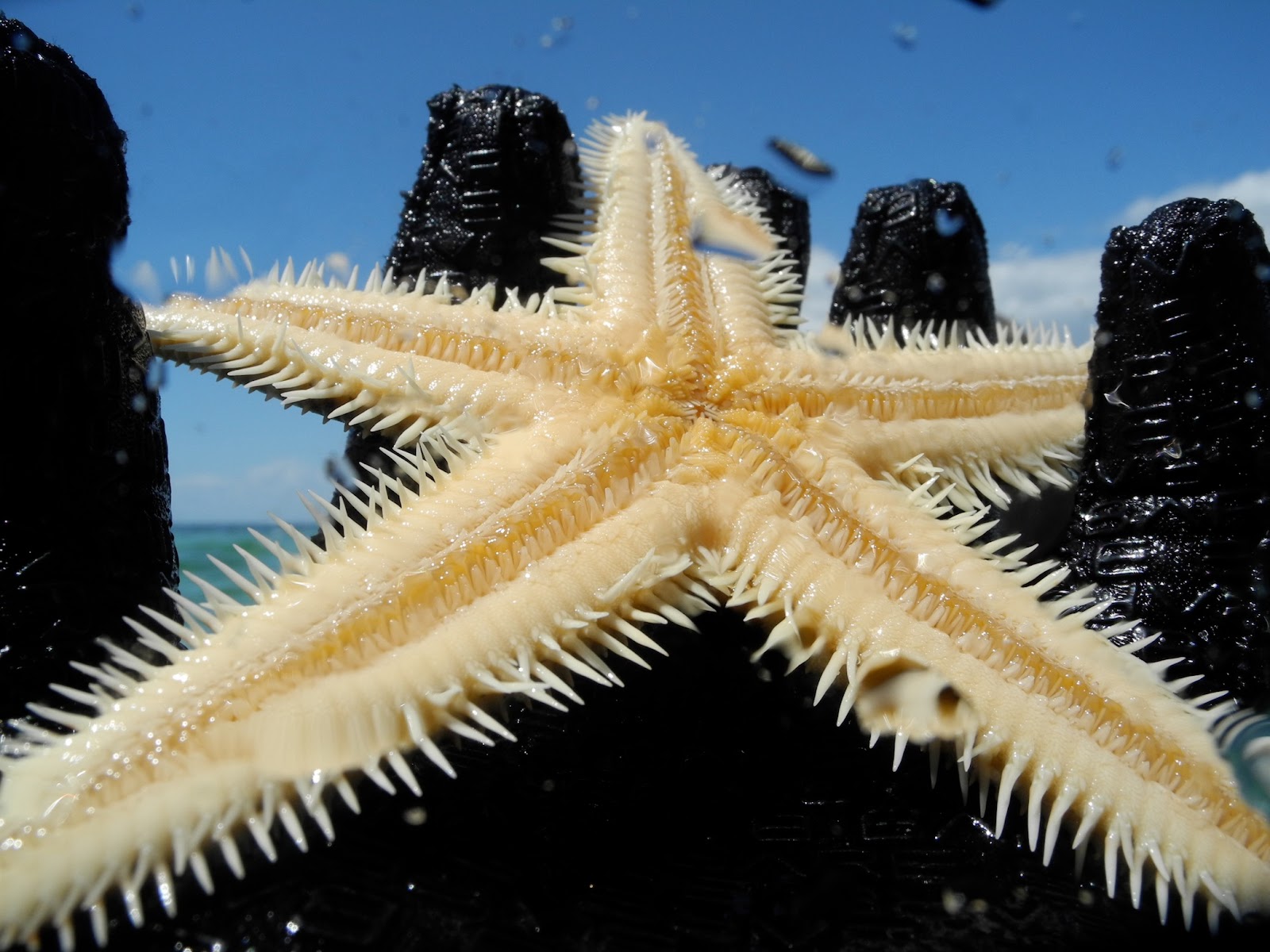
Beautiful sea stars blanket the sea floor. A spectrum of colors from one to the next.

(Adriana Weil)

(Tyler Roberts)

(Adriana Weil)


(Adriana Weil)


I found the big one eating the little one. Sea stars will push their stomach out of their body's to envelope and digest their prey.  A part of the stomach of the large one is still visible just in the center of it. (Adriana Weil)

Spiny Sea Star (Adriana Weil)


Had I all the space and time in the world to show you what I have seen, it would still fall short the real thing...

Even algae can surprise you with the shape it takes. (Adriana Weil)

Cat Eye Shark (Chris Mull)

Do you see him? (Adriana Weil)


It is astounding, the emotion you can feel from a turtles eye. (Adriana Weil)

Pied Cormorants and Australian Pelican (Fanny Vessaz)

Sharks of Australia (Fanny Vessaz)


Wednesday, December 21, 2011

Still Half Full

My time at Shark bay has been an unforgettable adventure so far, but now our amazing research team is breaking up.  While Kirk, Adriana and I are staying put to work for a few more months the others have all taken off to pursue other endeavors.  Our captain and commander Jordy was the first to go.  He was the one that put together our unstoppable team of researching superheroes.  Next AnnaRose was off and back to Oregon for a cold but I am sure very happy reunion with the beautiful Pacific Northwest.  Fanny, our own Swiss Miss was the last to go.  She is making her way to Madagascar and to the next lucky group who was smart enough to hire her.  We will miss you guys and all the great times we have shared together.


It was sad to watch them go but there is still much work here to be done here and our focus stays on the priorities.  We have finished the set up of our sea grass exclosure experiment and are now beginning to record the progress of it.  The winds are picking up every day and closing with it the window of our potential work time.  You cannot dive a floating hookah system in large waves and you cannot find turtles in it either, but such is the nature of fieldwork.  So we sit and we wait for that moment when the wind drops out and then we have to move like a kangaroo out of the bush and jump into action.

We have the system down now and in the case of a serious rush I think we could make it into the water in less then 30 minutes.  That includes getting all the gear on the boat, fueling up and squeezing in a quick snack.  Once we are on the water we all know what has to be done and the objectives are always quite clear.  We still have yet to get to the sharking portion of the job but as the lowest priority that has been expected.  I stay hopeful that we will have good enough weather in the next months for at least a few days day of sharking.

For now I wait and work on small projects around our field site.  We are expanding the area and building a large framed roof to cover the vital bits, meaning the main caravan, which is home to all our electronics and important but temperamental equipment.  We have turtle videos that must be watched and transcribed as well as ever increasing data to enter.

And now a few photos of the team.
Our crew + Chris at Guichenault (AnnaRose Adams)

Thanksgiving with the Dolphin Girls


Our crew + Chris - Jordy (Adriana Weil)

Just the kids (Adriana Weil)


Sunset cruise around the bay (Adriana Weil)

A little yoga (Adriana Weil)


Tuesday, November 29, 2011

Turtles Turtles Turtles

Here are a few pictures of turtles and other events that take place on the average work day for us in Shark Bay, Australia.


Oh that Tiger Shark

Fanny and I with a beautifully posing Green Turtle

Jordy and I releasing the beast
They just keep getting bigger.

Loggerhead equipped with GoPro

Hookah

Building Underwater Fences

Adriana's got this turtle

Launching Cuvier under Captain Kirk's supervision. (taken by Simon Alan)

Lets find us some turtles (taken by Simon Alan)